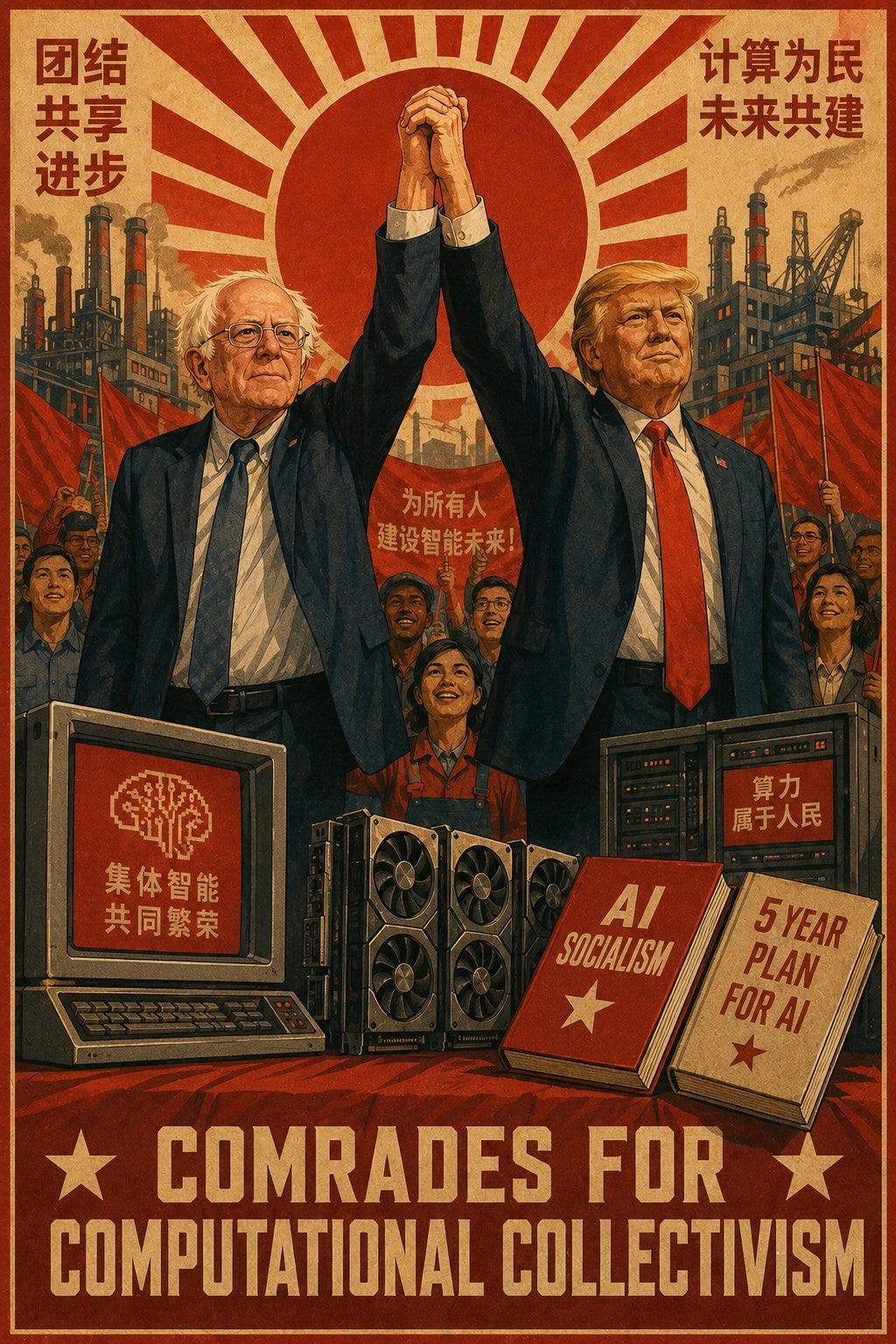
AI socialism has arrived in America with the Trump Administration taking a 5% stake in OpenAI. Other firms will almost certainly be expected to follow suit.
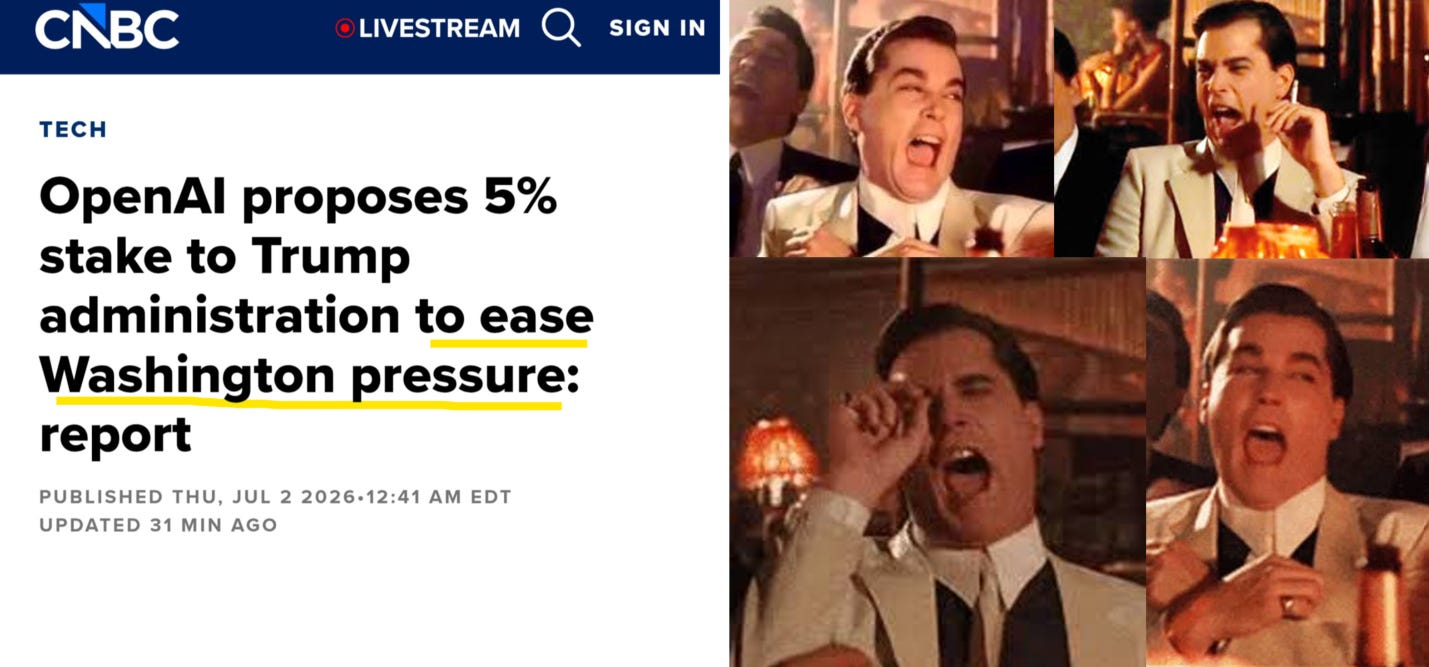
Incredibly, America heads into its independence weekend by proposing to make some of our largest companies dependent upon government. And it is absolutely hilarious how, as this CNBC headline notes, OpenAI apparently considers this move a way "to ease Washington pressure" on them and the industry when, in reality, it is just the beginning of government's leash tightening around their throats.
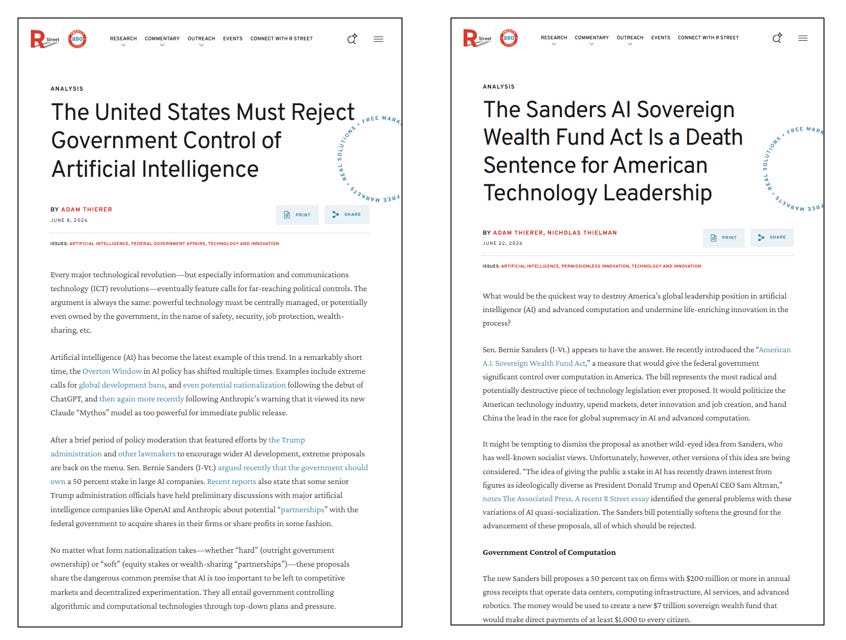
Just one month ago, I penned an essay on why "The United States Must Reject Government Control of Artificial Intelligence." Since then, Sen. Bernie Sanders has floated an AI nationalization bill (which I wrote about here) and now the Trump administration is taking direct stakes in AI firms. Yet they say bipartisanship is dead in Washington! LOL. Apparently we are all just AI socialists now, marching hand-in-hand towards computational collectivism.
You might say this is no big deal. Hey, it’s just a little 5 percent slice of sweet AI pie for Uncle Sam. Well, as Dean Ball correctly notes, “It will never stop at 5%. It will go on and on and on. The governance will become a nightmare. Political capture will be real. And it will generate precisely no goodwill with the public. None, if they themselves see no direct financial benefit.”
He is correct. Most Americans will look at this as a shady scam, or even a prelude to a bailout if the AI bubble bursts and government “partners” come looking for a handout. This does nothing to soothe public fears about AI or AI firms. Instead, the group that benefits most from this move will be politicians. They gain significant more control over the AI industry through these “partnerships” with industry and they will have plenty of demands they expect to have satisfied.
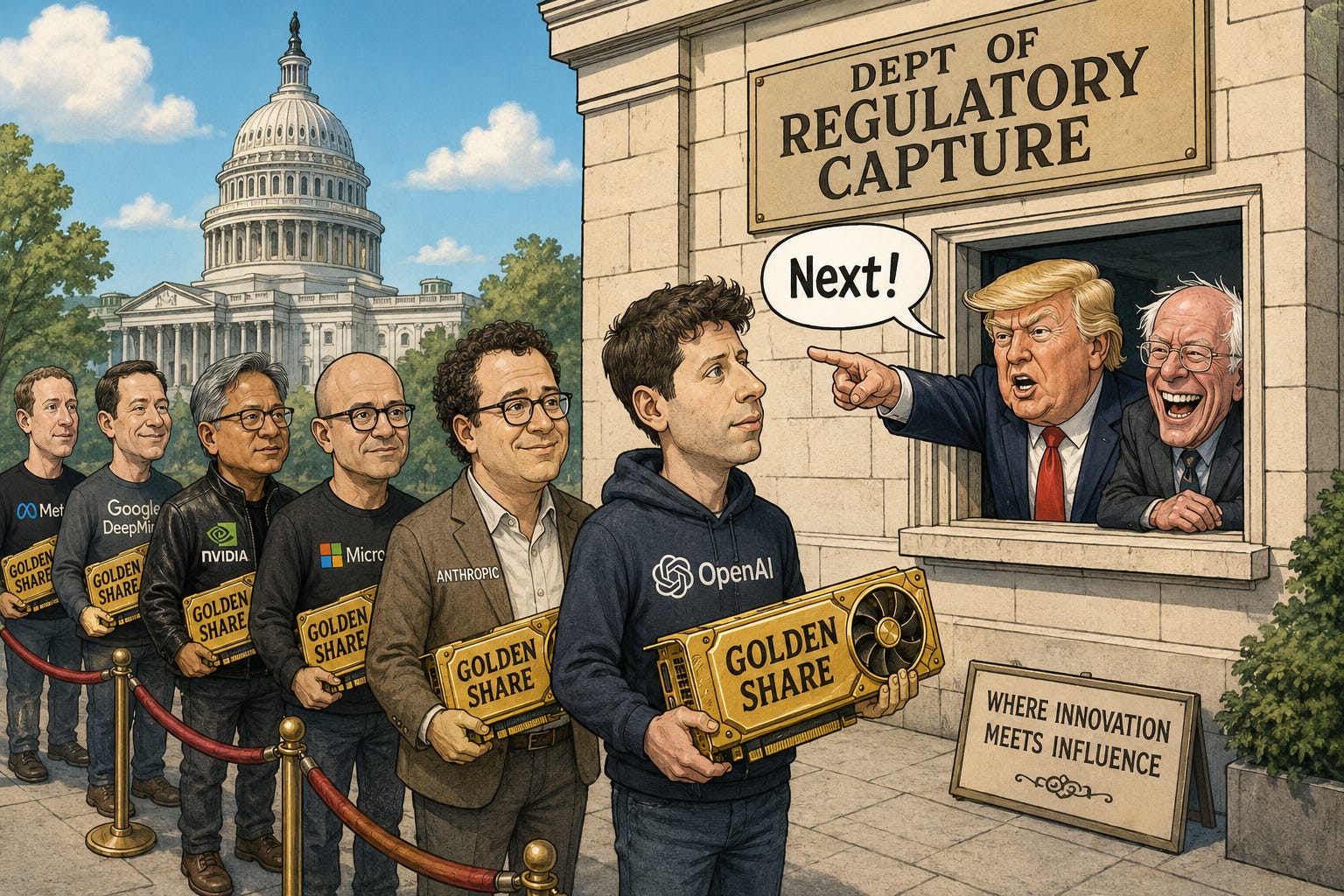
Of course, the companies who are cutting deals with government will expect something in return beyond just good will. While one would hope that some tech CEOs would have the courage to stand up to the takeover of their industry, they will more likely just fall all over each other in a rush to make sure they are first in line to curry favor with their new government masters.
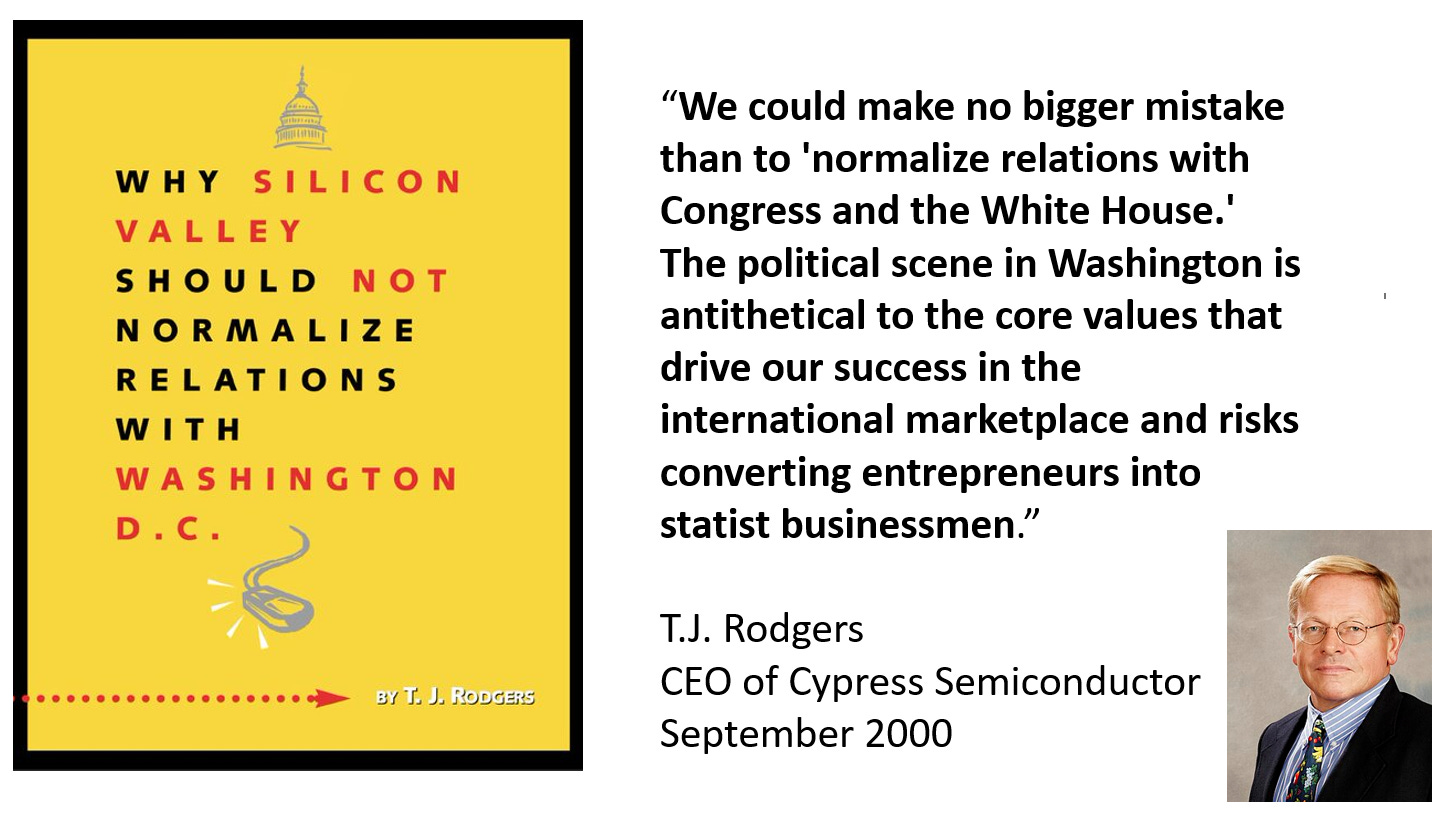
Back in 2000, Cypress Semiconductor CEO T.J. Rodgers pleaded with the tech community to resist letting Uncle Sam into their board rooms in this fashion. In a speech and corresponding essay on “Why Silicon Valley Should Not Normalize Relations With Washington, D.C.,” Rodgers said:
“We could make no bigger mistake than to ‘normalize relations with Congress and the White House.’ The political scene in Washington is antithetical to the core values that drive our success in the international marketplace and risks converting entrepreneurs into statist businessmen.”
Alas, that’s where we’re headed now. Statist businessmen in bed with Big Government. The fact this is starting to unfold on America’s 250th independence day birthday makes it all the more sickening. Perhaps Sam Altman’s message to employees this weekend will be: Today we celebrate our DEPENDENCE Day!

It is at times like this when I like to pull out some of my favorite quotes about regulatory capture from progressive icons like Woodrow Wilson and Ralph Nader, as well as Carter-appointee Alfred Kahn. Here’s what they had to say about the dangers of crony capitalism in the past, and it is more relevant than ever today:
Woodrow Wilson, The New Freedom: A Call For the Emancipation of the Generous Energies of a People (1913) at 201-202:
“If the government is to tell big business men how to run their business, then don’t you see that big business men have to get closer to the government even than they are now? Don’t you see that they must capture the government, in order not to be restrained too much by it? Must capture the government? They have already captured it. Are you going to invite those inside to stay? They don’t have to get there. They are there.”
Mark Green and Ralph Nader, “Economic Regulation vs. Competition: Uncle Sam the Monopoly Man,” Yale Law Journal 82, no. 5 (April 1973), 876
“a kind of regular personnel interchange between agency and industry blurs what should be a sharp line between regulator and regulatee, and can compromise independent regulatory judgment. In short, the regulated industries are often in clear control of the regulatory process.”
Alfred Kahn, The Economics of Regulation: Principles and Institutions (1971):
“When a commission is responsible for the performance of an industry, it is under never completely escapable pressure to protect the health of the companies it regulates, to assure a desirable performance by relying on those monopolistic chosen instruments and its own controls rather than on the unplanned and unplannable forces of competition.” (p. 12) “Responsible for the continued provision and improvement of service, [the regulatory commission] comes increasingly and understandably to identify the interest of the public with that of the existing companies on whom it must rely to deliver goods.” (p. 46)
It is important to consider these developments in light of other business that major AI firms have before the government. First, they want huge procurement contracts to come their way. Those contracts are big money and they don’t want to lose them to rivals. Golden share “partnerships” become a potential prerequisite for getting in on those contracts. You scratch my back, I’ll scratch yours.
Second, these large AI firms face regulatory pressure on the model development side, with politicians in both parties looking to have greater say over AI models in the name of “safety.” The feds have even pulled AI models off the market without clear explanation, meaning we now have a quasi-licensing regime for frontier models without any formal legal standards or transparency.
And now come “voluntary” equity stakes shared in a “partnership” with government. That makes it even easier for federal officials to bark out orders and jawbone firms into changing their policies—including their content / speech policies—such that they are more in line with current admin thinking, regardless of who is in the White House.
Kyle Saunders has astutely observed that one cannot help but get the whiff of petrostate politics coming to AI policy. He notes:
There’s a wrinkle here that should worry everyone. A country sitting on a giant claim to AI’s output starts to rhyme with a petrostate. The analogy isn’t clean, of course, since the rent here is domestic and still has to be pried out of a working economy rather than pumped out of the ground, but the political shape carries over, right?
Indeed it does, and it has profound ramifications for the growing politicization of both model design / outputs and downstream algorithmic innovations and speech. With Beltway politicians having some direct stakes in AI firms, they will obviously want to have more of a say about a wide variety of things, include content choices that they perhaps find out of “alignment” with their perspectives and priorities.
I won’t rehash all the other problems with these equity share arrangements, but instead just point back to my previous essay identifying the four primary dangers with AI nationalization as well as this essay that I wrote with my colleague Nicholas Thielman on how “The Sanders AI Sovereign Wealth Fund Act Is a Death Sentence for American Technology Leadership.” Now that Trump and Bernie are aligned on government takeover of AI, it is really just a question of ironing out the details.
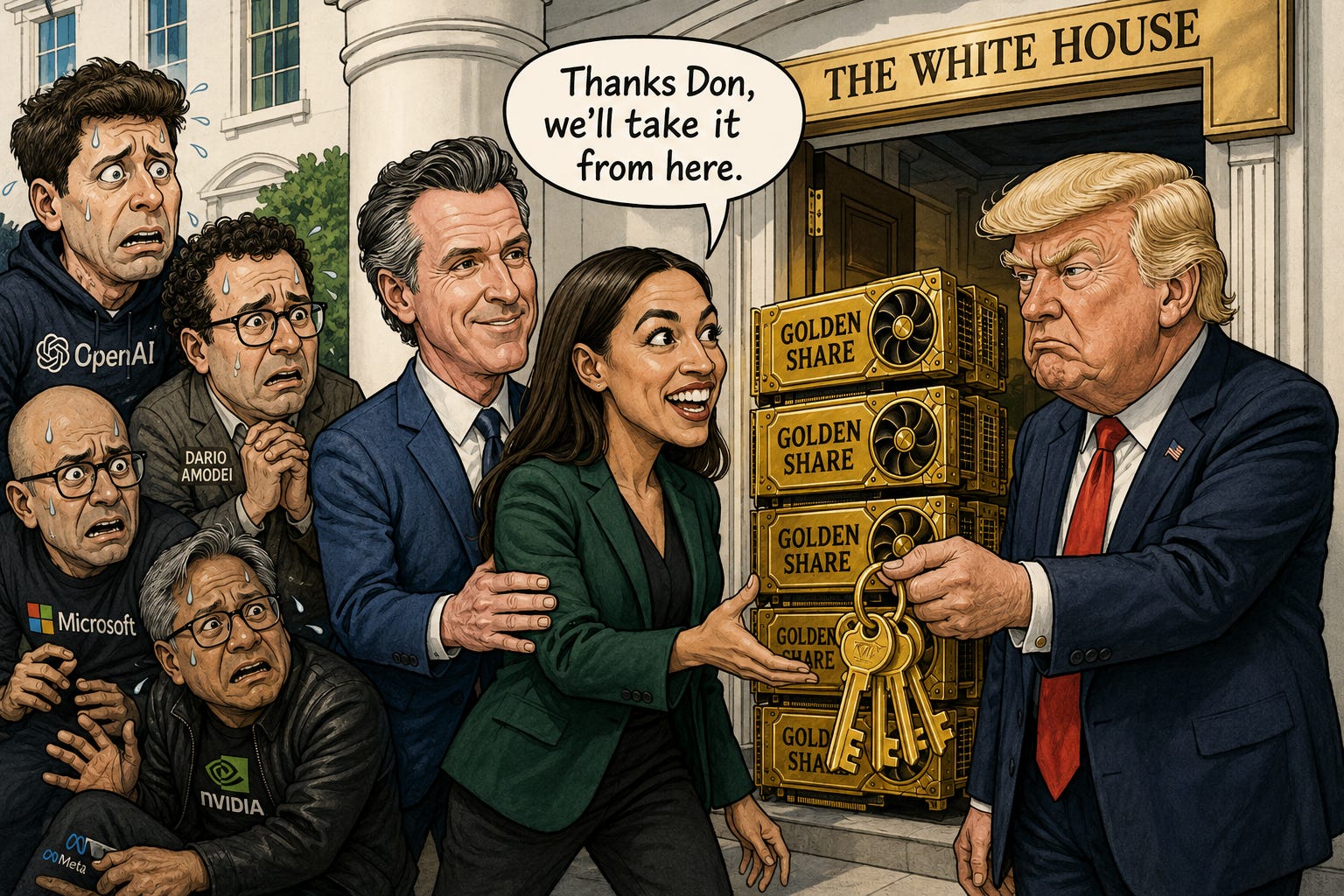
Finally, it certainly will be interesting to see how a future President AOC or President Newsom go about managing AI firms once they control corporate golden shares thanks to Donald Trump. And can you even imagine what would have happened just two years ago had the Biden White House proposed government stakes in any AI company? Every GOP lawmaker in the land would have lost their minds and been falling all over each other in a mad rush to get on Fox News and denounce that sort of government takeover. Where are those supposed conservatives at today now that their leader is behaving like a democratic socialist?